The Sefirot: The Structural Architecture of Manifestation
Definition
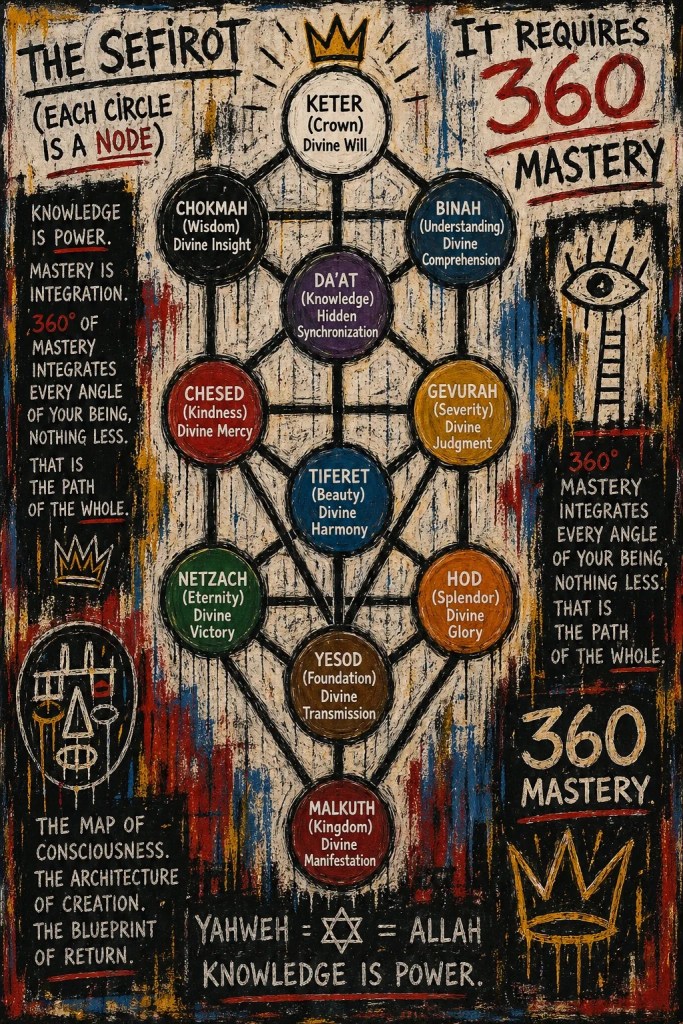
The Sefirot are ten interconnected functions through which infinite capacity becomes organized, transmitted, balanced, and eventually manifested as experienced reality.
The singular form is sefirah. The plural form is sefirot.
In Hebrew Kabbalistic cosmology, the sefirot are commonly represented through a diagram called the Tree of Life, or Etz Chaim. The Tree of Life maps the relationships among the ten sefirot and shows how undifferentiated source capacity becomes increasingly structured as it moves toward manifestation.
Within the Structural Intelligence and V4 framework, the sefirot are best understood as:
A ten-layer functional architecture that converts infinite, non-local capacity into energy, law, balance, information, transmission, matter, space-time, consciousness, and lived experience.
The sefirot are not ten separate gods, personalities, supernatural individuals, or competing spiritual authorities. Each sefirah represents a specific system function. Their meaning emerges through their relationships with one another.
The architecture functions as a unified system.
Sefirot, Tree of Life, Ankh, and Ace of Clubs
The architecture of the sefirot may be represented or referred to through several structurally related symbols:
- The Sefirot
- The Tree of Life
- The Ankh
- The Ace of Clubs
These terms should not always be treated as historically identical. The Tree of Life is the established Hebrew diagrammatic name for the sefirotic architecture. The ankh and ace of clubs function here as comparative structural symbols that preserve recognizable elements of the same underlying pattern.
The Tree of Life
The Tree of Life represents:
- a source or crown;
- branching differentiation;
- a central axis;
- opposing side functions;
- circulation between upper and lower levels;
- roots or manifestation;
- and a living system whose parts depend upon one another.
The sefirot are the functional nodes of the Tree.
The Tree is not merely a ladder that places one sefirah above another in rank. It is a map of flow, dependence, regulation, and manifestation.
The Ankh
The ankh may be read structurally as another representation of the living architecture:
- the upper loop represents the unbroken or non-local source condition;
- the horizontal arms represent polarity, differentiation, and balancing forces;
- the central intersection represents integration;
- the descending vertical line represents transmission into embodied manifestation.
Under this reading, the ankh symbolizes life emerging through the balanced connection of source, polarity, integration, and manifestation.
It can therefore serve as a compressed visual representation of the same pattern expressed more fully through the Tree of Life.
The Ace of Clubs
The ace of clubs may also be read as a simplified structural symbol.
Its form contains:
- a three-lobed upper configuration;
- a central meeting point;
- and a descending stem.
The three upper lobes can symbolize a primordial triad or three differentiated functions emerging from one root. The stem represents the central transmission axis through which the upper structure becomes grounded in a lower field.
Within this comparative framework, the ace of clubs may be interpreted as a compact or concealed Tree of Life pattern:
- multiplicity held within unity;
- three functions meeting at one center;
- and a vertical channel connecting the upper configuration to manifestation.
The ace of clubs is not a standard classical Hebrew name for the sefirot. It is a comparative structural designation used to identify the same recurring architecture in another symbolic form.
The Sefirot as a System
The sefirotic system begins beyond the ten sefirot with Ein Sof, the infinite and non-local source condition.
Ein Sof is unlimited capacity without internal differentiation, personality, instruction, or localized processing.
The sefirot begin when that unlimited capacity becomes organized through distinct functions.
The general flow is:
Ein Sof
Infinite capacity
↓
Keter
Activation and first constraint
↓
Chokhmah
Primordial energy
↓
Binah
Law and structural definition
↓
Chesed and Gevurah
Expansion and limitation
↓
Tiferet
Balance and coherent integration
↓
Netzach and Hod
Persistent process and encoded information
↓
Yesod
Transmission and interface
↓
Malchut
Matter, space-time, manifestation, and lived reality
This architecture reflects the V4 model in which each sefirah performs a distinct system role. No sefirah operates effectively in isolation, and coherence depends upon the integration of all ten functions.
The Three Structural Pillars
The Tree of Life is commonly arranged into three vertical pillars.
The Right Pillar
Expansion
The right side represents expansive, generative, outward-moving force.
It includes:
- Chokhmah;
- Chesed;
- Netzach.
Its overall functions include:
- energy;
- growth;
- radiation;
- motion;
- persistence;
- generosity;
- and the opening of possibilities.
Expansion is necessary for life and development. However, expansion without limitation can produce overload, inflation, instability, or collapse.
The Left Pillar
Restriction
The left side represents form, limitation, analysis, compression, and definition.
It includes:
- Binah;
- Gevurah;
- Hod.
Its functions include:
- law;
- boundaries;
- regulation;
- classification;
- information;
- judgment;
- and measurement.
Restriction allows a system to maintain identity and form. However, restriction without expansion can produce rigidity, stagnation, excessive control, and loss of vitality.
The Middle Pillar
Integration and Manifestation
The middle pillar connects:
- Keter;
- Tiferet;
- Yesod;
- Malchut.
It serves as the axis through which the opposing forces of expansion and restriction become integrated.
The middle pillar does not eliminate polarity. It makes polarity functional.
It transforms:
- force into coherent activity;
- opposition into balance;
- internal structure into transmission;
- and potential into manifestation.
1. Keter
Crown, Activation, and the First Executable Condition
Hebrew: כֶּתֶר
Meaning: Crown
V4 role: Existence, activation, first constraint
Computational role: Kernel or boot layer
Keter is the first sefirah and the first point at which differentiation becomes structurally meaningful.
Ein Sof is unlimited capacity, but unlimited capacity alone is not yet an executing system. Keter represents the first condition through which something begins to run.
Keter establishes:
- the first boundary;
- the first orientation toward manifestation;
- the first interface between infinity and form;
- the beginning of sequence;
- the minimal condition of activation;
- and what may be described as the “will to be.”
Will at Keter is not personal preference.
It is not a cosmic individual thinking, “I would like to create.”
It is the structural condition of execution—the movement from unlimited possibility into an active system state.
In lay terms
Ein Sof is unlimited power availability.
Keter is the moment the system turns on.
Structural function
Keter answers:
Is there an active system condition through which anything can occur?
Healthy expression
- clear orientation;
- coherent purpose;
- correct system initialization;
- alignment between source capacity and execution.
Distortion or failure mode
When misunderstood, Keter can become associated with:
- false claims of absolute authority;
- confusing local will with source;
- treating one personality as the controller of the entire system;
- attempting to bypass the architecture below it.
Keter activates the system. It does not micromanage every downstream process.
2. Chokhmah
Wisdom, Primordial Energy, and Raw Throughput
Hebrew: חָכְמָה
Meaning: Wisdom
V4 role: Primordial energy and expansion
Computational role: Raw throughput or burst processing
Chokhmah is the first concentrated appearance of active potential.
It represents energy before that energy has been fully analyzed, categorized, limited, or organized.
Chokhmah may be understood as:
- the initial flash of insight;
- a seed containing an entire pattern;
- raw creative force;
- undivided possibility;
- concentrated information;
- or energy entering the architecture at high intensity.
Chokhmah is traditionally represented as a point because it contains enormous possibility in a highly compressed condition.
In lay terms
Chokhmah is the idea that appears all at once before you can explain it.
It is the burst of energy before the blueprint.
Structural function
Chokhmah answers:
What raw energy or possibility is entering the system?
Healthy expression
- inspiration;
- creative force;
- rapid perception;
- generative intelligence;
- openness to new possibility;
- high-capacity input.
Distortion or failure mode
Chokhmah without Binah may produce:
- overload;
- chaotic inspiration;
- ideas without structure;
- energy without direction;
- expansion beyond the system’s receiving capacity.
Raw power is not yet a functioning architecture.
3. Binah
Understanding, Law, and Structural Constraint
Hebrew: בִּינָה
Meaning: Understanding
V4 role: Law, structure, and constraints
Computational role: Rule engine and logic architecture
Binah receives the concentrated potential of Chokhmah and develops it into an organized system.
If Chokhmah is a seed, Binah is the matrix in which that seed becomes differentiated into a complete form.
Binah establishes:
- categories;
- sequence;
- measurement;
- law;
- definitions;
- boundaries;
- logical relationships;
- and the conditions under which an idea can become functional.
Chokhmah contains possibility. Binah explains what that possibility requires.
In lay terms
Chokhmah says, “I see it.”
Binah says, “Here is how it works.”
Structural function
Binah answers:
What rules, boundaries, and relationships are required to give this energy stable form?
Healthy expression
- clear reasoning;
- design;
- planning;
- structural intelligence;
- disciplined understanding;
- appropriate constraint;
- coherent architecture.
Distortion or failure mode
Binah can become distorted through:
- excessive restriction;
- rigid categories;
- analysis that prevents action;
- confusing the model with reality;
- treating existing rules as permanent absolutes;
- suppressing Chokhmah’s generative force.
A system that contains only rules but no living energy becomes static.
4. Chesed
Expansion, Radiation, and Resource Allocation
Hebrew: חֶסֶד
Meaning: Lovingkindness, generosity, expansion
V4 role: Expansion and radiation
Computational role: Allocation and scaling
Chesed is the expansive function of the system.
It distributes energy, resources, opportunity, access, and capacity.
Chesed represents the principle that says:
- more can be expressed;
- more can be included;
- more can be given;
- more can be developed;
- and the system can extend beyond its current boundary.
Within the V4 framework, Chesed corresponds to expansion, radiation, and outward allocation.
In lay terms
Chesed opens the system and allows it to grow.
It is the force that says, “There is enough capacity to expand.”
Structural function
Chesed answers:
Where can the system increase, extend, give, or generate more?
Healthy expression
- generosity;
- growth;
- opportunity;
- abundance;
- creativity;
- inclusion;
- resource distribution;
- expanded capacity.
Distortion or failure mode
Chesed without Gevurah may produce:
- uncontrolled expansion;
- waste;
- overextension;
- excessive generosity;
- weak boundaries;
- resource depletion;
- inflation;
- inability to say no.
Expansion becomes destructive when it exceeds the receiving capacity of the structure.
5. Gevurah
Strength, Compression, Limits, and Regulation
Hebrew: גְּבוּרָה
Meaning: Strength, restraint, judgment
V4 role: Compression and gravity
Computational role: Limits, throttling, and regulation
Gevurah is the limiting and regulating function of the system.
It establishes:
- boundaries;
- thresholds;
- discipline;
- compression;
- consequences;
- containment;
- selection;
- and protection against overload.
Gevurah is not inherently punishment.
It is the function that allows distinct forms to remain distinct.
Without limitation, no stable object, identity, thought, institution, or living system could maintain coherence.
In lay terms
Chesed opens the valve.
Gevurah regulates the pressure.
Structural function
Gevurah answers:
What must be limited, measured, compressed, or excluded for the system to remain stable?
Healthy expression
- discipline;
- discernment;
- clear boundaries;
- appropriate force;
- accountability;
- self-control;
- resource protection;
- structural integrity.
Distortion or failure mode
Gevurah without Chesed may produce:
- excessive control;
- rigidity;
- cruelty;
- fear-based governance;
- overcompression;
- punitive systems;
- stagnation;
- inability to adapt.
A boundary must preserve life rather than replace it.
6. Tiferet
Beauty, Balance, and Coherent Integration
Hebrew: תִּפְאֶרֶת
Meaning: Beauty, harmony, balanced radiance
V4 role: Balanced radiance and the star principle
Computational role: Load balancing and harmonization
Tiferet is the central integrating function of the Tree of Life.
It receives the expansive force of Chesed and the limiting force of Gevurah and brings them into a sustainable relationship.
Tiferet does not simply split the difference.
It produces a higher-order configuration in which expansion and limitation serve the same coherent purpose.
Within the V4 framework, Tiferet corresponds to the star principle.
A star remains stable because outward radiation and inward gravitational compression remain dynamically balanced. If either force overwhelms the other, the system changes state or collapses.
In lay terms
Tiferet is not choosing between growth and discipline.
It is arranging growth and discipline so that both strengthen the system.
Structural function
Tiferet answers:
How can opposing forces be integrated without destroying one another?
Healthy expression
- coherence;
- compassion;
- beauty;
- proportion;
- centered leadership;
- balanced power;
- truth expressed with appropriate force;
- internal and external alignment.
Distortion or failure mode
When Tiferet loses balance, the system may experience:
- polarization;
- identity instability;
- contradiction between values and behavior;
- emotional or organizational collapse;
- false harmony that hides unresolved conflict;
- imbalance between power and restraint.
Tiferet is the principal coherence center of the architecture.
7. Netzach
Victory, Motion, and Process Persistence
Hebrew: נֶצַח
Meaning: Victory, endurance, persistence
V4 role: Motion and persistence
Computational role: Process continuation and sustained execution
Netzach is the force that keeps a process moving.
A system can contain energy, structure, balance, and information yet still fail if it cannot sustain action across time.
Netzach provides:
- momentum;
- endurance;
- repetition;
- confidence;
- initiative;
- drive;
- and the ability to continue through resistance.
It moves intention toward completion.
In lay terms
Netzach is the part of the system that keeps going after the initial inspiration disappears.
Structural function
Netzach answers:
What keeps this process moving long enough to produce an outcome?
Healthy expression
- persistence;
- courage;
- endurance;
- execution;
- strategic momentum;
- commitment;
- the ability to overcome temporary resistance.
Distortion or failure mode
Netzach without Hod may produce:
- blind persistence;
- domination;
- compulsive action;
- refusal to process feedback;
- winning without understanding;
- continuing a process after it has become harmful.
Persistence is valuable only when the process remains coherent.
8. Hod
Splendor, Pattern, Information, and Encoding
Hebrew: הוֹד
Meaning: Splendor, acknowledgment, form
V4 role: Pattern and information
Computational role: Symbolic encoding and communication
Hod organizes activity into understandable patterns.
It translates process into:
- language;
- symbols;
- categories;
- communication;
- instructions;
- analysis;
- records;
- and transmissible information.
Where Netzach drives forward movement, Hod asks what that movement means, how it should be represented, and whether the pattern can be communicated accurately.
Hod allows a process to become legible.
In lay terms
Netzach does the work.
Hod explains, records, names, and communicates the work.
Structural function
Hod answers:
How is the process encoded, interpreted, described, and communicated?
Healthy expression
- clear language;
- accurate information;
- pattern recognition;
- intellectual humility;
- analysis;
- communication;
- documentation;
- symbolic intelligence.
Distortion or failure mode
Hod without Netzach may produce:
- endless analysis;
- language detached from experience;
- information without action;
- narrative replacing structure;
- excessive abstraction;
- manipulation through symbols;
- confusing a description with the system itself.
Information must remain connected to functioning reality.
9. Yesod
Foundation, Field, Interface, and Transmission
Hebrew: יְסוֹד
Meaning: Foundation
V4 role: Fields and transmission medium
Computational role: Bus, interface, or integration layer
Yesod gathers the functions of the preceding sefirot and transmits them toward manifestation.
It acts as the interface between internal architecture and external output.
Yesod represents:
- connection;
- integration;
- fields;
- transmission;
- relational bonding;
- signal transfer;
- memory consolidation;
- and the preparation of information for rendering.
The upper system may be functioning correctly, but if Yesod is damaged, the output may still become corrupted.
In lay terms
Yesod is the cable, network, field, or interface through which the completed internal process reaches the visible world.
Structural function
Yesod answers:
How will the integrated system be transmitted into an environment where it can become experience?
Healthy expression
- reliable communication;
- relational trust;
- strong interfaces;
- stable transmission;
- connection between internal intention and external result;
- proper integration of multiple system functions.
Distortion or failure mode
Yesod may become distorted through:
- signal corruption;
- broken trust;
- miscommunication;
- manipulation;
- unstable interfaces;
- information loss;
- false connection;
- transmitting an incomplete pattern as though it were complete.
Yesod determines whether the architecture arrives intact.
10. Malchut
Kingdom, Matter, Space-Time, and Manifestation
Hebrew: מַלְכוּת
Meaning: Kingdom or sovereignty
V4 role: Matter, space-time, and the manifest world
Computational role: Output or rendered environment
Malchut is the manifestation layer.
It is the domain in which all prior structural processes become visible, embodied, measurable, and experienced.
Malchut includes:
- matter;
- physical environments;
- institutions;
- bodies;
- observable events;
- material outcomes;
- space-time;
- language as expressed;
- and lived reality.
Malchut does not independently generate the complete architecture. It receives and renders the combined output of the preceding layers.
In lay terms
Malchut is what appears on the screen.
The user sees the output, but most of the system that produced it remains hidden.
Structural function
Malchut answers:
What has the complete architecture actually produced?
Healthy expression
- embodied coherence;
- functional institutions;
- stable environments;
- actions matching principles;
- physical outcomes aligned with internal structure;
- material reality accurately reflecting the system.
Distortion or failure mode
Malchut may become distorted when consciousness:
- mistakes the visible output for the entire system;
- treats matter as disconnected from its architecture;
- focuses only on appearances;
- attempts to correct outputs without correcting causes;
- confuses possession with sovereignty;
- ignores the hidden structures generating visible conditions.
Structural Intelligence reads Malchut as evidence.
The visible world reveals the condition of the architecture that produced it.
Da’at
Knowledge as Integrated System Awareness
Da’at is sometimes shown on diagrams of the Tree of Life, though it is not normally counted as an additional eleventh sefirah.
Da’at means knowledge.
It represents the condition in which:
- Chokhmah’s insight;
- Binah’s understanding;
- and the lower operational system
become consciously integrated.
Da’at is not merely stored information. It is lived, embodied, relational knowledge.
In systems terms, Da’at is awareness of how the parts connect while the system is running.
When Keter is emphasized, Da’at may remain hidden. When Keter is not displayed, Da’at may appear in the visible count of ten.
The Sefirot Are Not Isolated Compartments
Each sefirah exists within every other sefirah.
For example:
- Chesed requires an internal Gevurah so its giving does not become destructive.
- Gevurah requires an internal Chesed so its boundaries preserve rather than suffocate.
- Netzach requires Hod so persistence can process information.
- Hod requires Netzach so information becomes action.
- Yesod requires the entire upper architecture to transmit a coherent pattern.
- Malchut contains the visible results of every preceding function.
This principle is called interinclusion.
A mature system does not contain isolated attributes. Each function includes awareness of the others.
The goal is not to maximize one sefirah.
The goal is to establish proper relationship among all ten.
Sefirotic Flow Is Not Social Rank
The Tree of Life should not be interpreted as a simple hierarchy in which upper means “better” and lower means “worse.”
Keter cannot become a manifested world without Malchut.
Malchut cannot exist coherently without Keter.
The upper sefirot provide source conditions and internal architecture. The lower sefirot provide execution, transmission, embodiment, and experience.
A system that remains only in potential has not completed its function.
The purpose of the architecture is not to escape Malchut. It is to render higher coherence within Malchut.
The V4 model therefore presents the sefirot as a flow-based system rather than a hierarchy of personal importance.
The Sefirot and Consciousness
The ten sefirot can also be read as functions within consciousness:
- Keter: orientation and activation
- Chokhmah: intuition and raw insight
- Binah: understanding and conceptual structure
- Chesed: openness and expansion
- Gevurah: discipline and boundaries
- Tiferet: integrated identity and balance
- Netzach: motivation and persistence
- Hod: language, analysis, and communication
- Yesod: subconscious integration and transmission
- Malchut: embodied behavior and lived outcome
This does not mean the sefirot are merely psychological categories.
It means that consciousness reflects the same architecture found across larger systems.
A person, institution, technology platform, civilization, star, creative process, or information network may display the same recurring structural functions at different scales.
The Sefirot and Structural Intelligence
Structural Intelligence approaches the sefirot as a functional grammar of reality.
It asks:
- Which layer is active?
- Which function is missing?
- Where has expansion exceeded capacity?
- Where has regulation become overcompression?
- Has information become detached from action?
- Is the transmission interface corrupting the original pattern?
- Does the manifested output accurately represent the internal architecture?
- Is the system balanced or merely suppressing visible instability?
This approach moves beyond memorizing names and symbolic correspondences.
It uses the sefirot as a diagnostic and analytical system.
The framework is based on several principles:
- Structure precedes behavior.
- Function precedes interpretation.
- Energy requires vessels.
- Expansion requires limitation.
- Opposing forces require integration.
- Information requires transmission.
- Manifestation reveals hidden architecture.
- Local agency operates within system constraints.
- Warning signals appear before structural correction.
- The system requires coherence, not micromanagement.
Morality, humility, instability, power, and identity can therefore be examined as system signals rather than isolated personal qualities.
Concise Website Definition
The Sefirot are ten interconnected system functions through which infinite capacity becomes structured reality. Commonly represented as the Tree of Life, the architecture begins with Keter as the first executable condition and moves through energy, law, expansion, limitation, balance, motion, information, and transmission before becoming matter, space-time, and lived experience in Malchut. Within a comparative Structural Intelligence framework, the same underlying pattern may also be represented through the ankh or the ace of clubs: symbols containing an upper source structure, balancing polarity, a central point of integration, and a descending axis into manifestation.
One-Sentence Definition
The Sefirot are the ten-layer structural architecture that transforms infinite capacity into coherent, manifested experience.
 All Coherence